
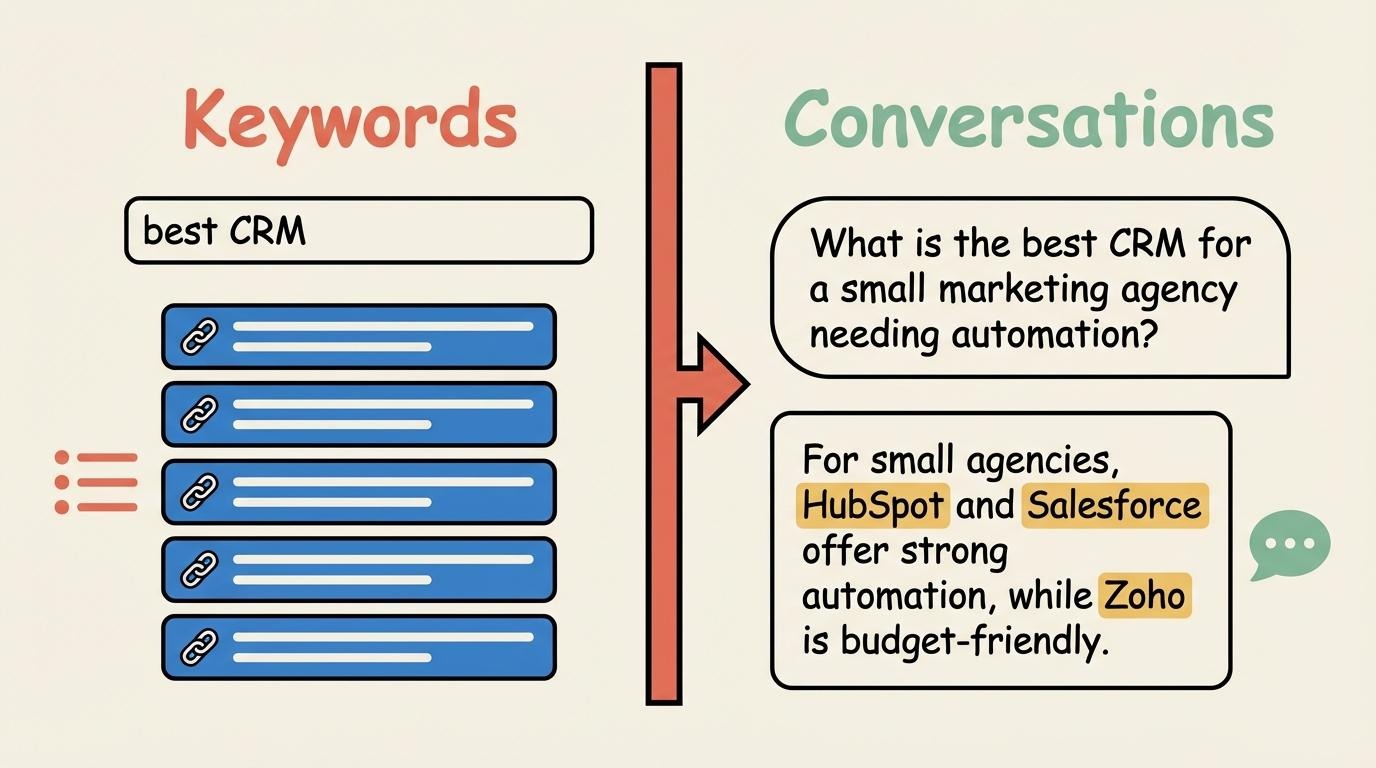
People no longer type three-word queries into Google. They ask full questions. They have conversations with AI tools. Your content strategy must match the way people actually search now.
This shift from keyword matching to conversational understanding is the foundation of answer engine optimization.
What Most Content Strategies Get Wrong
Content teams still start with keyword research spreadsheets. They find a term with high volume and low difficulty, write a 2,000-word post targeting it, and build backlinks. That process optimizes for an older version of search.
AI-powered search tools do not match keywords. They interpret intent. They pull from multiple sources to construct a single, synthesized answer. Your 2,000-word post might contain the right information, but if it is buried in filler, the AI model skips it.
The result: pages that rank well in traditional SERPs but never appear in AI-generated answers. Your traffic looks stable until AI Overviews expand to your category. Then it drops fast.
Keyword rankings measure where you appear on a list. AI citations measure whether machines trust your content enough to quote it. These are fundamentally different signals.
What a Conversation-First Content Strategy Requires
Shifting from keywords to conversations demands new capabilities. Here is what separates teams that succeed from those that keep recycling the old playbook.
Question-Based Content Architecture
Every page should answer a specific question clearly within the first two paragraphs. Use headers as questions. Provide direct answers before elaborating. AI models reward clarity over comprehensiveness.
Topical Authority Over Keyword Targeting
AI models assess whether your site is a credible source on a topic. That means clusters of related content, not isolated keyword plays. Build depth around your core topics. Link related pieces together. Show the machine you understand the subject broadly.
Integrated Channel Strategy
Conversational search blurs the line between paid and organic. A query that triggers an AI overview today might have been a paid click yesterday. You need a strategy that combines SEO, paid media, and AI optimization under one roof. Siloed teams miss these connections.
Speed and Iteration
Conversational search patterns change quickly. New queries emerge as AI tools gain users. The right partner tests, measures, and adjusts weekly. If your optimization cycle runs quarterly, you are already behind.
A disciplined approach to answer engine optimization builds this iterative speed into the process from the start.
How to Restructure Your Content for Conversational Search

- Audit your top pages for AI readability. Read each page as if you were an AI model. Can you extract a clear, direct answer in the first 100 words? If not, rewrite the opening.
- Convert keyword targets to question clusters. For every target keyword, list five to ten questions a buyer might ask. Create content that answers each one directly.
- Use structured data aggressively. FAQ schema, HowTo schema, and speakable schema all signal to AI models that your content is designed to be cited.
- Eliminate filler. Cut introductions that restate the title. Remove paragraphs that add words without adding information. AI models favor density of insight over length.
- Measure conversational visibility. Track your presence in ChatGPT, Perplexity, and AI Overviews for your target queries. A strong answer engine optimization framework connects these citations to actual business outcomes like pipeline and revenue.
Inaction Has a Compounding Cost
The brands building conversational content now are training AI models to cite them. Every citation reinforces their authority. Every reinforcement makes the next citation more likely.
This is a compounding advantage. The gap between early movers and late adopters widens with each passing month. There is no catching up by publishing more content later. The models have already learned who to trust.
Your competitors are restructuring their content right now. They are answering the questions your buyers ask AI tools. If your content still reads like a keyword-stuffed blog post from 2019, you will not be part of the conversation. And in modern search, if you are not part of the conversation, you do not exist.