
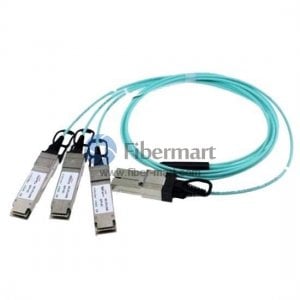
In the fast-evolving world of data centers and high-speed networking, the choice of cabling solutions plays a critical role in ensuring performance, reliability, and scalability. Among the latest technologies, the 100G QSFP28 active optical cable has emerged as a popular choice for data transmission, particularly when compared to traditional copper cabling solutions. This article explores the differences, advantages, and practical considerations of using 100G QSFP28 active optical cables versus conventional copper connections, focusing on performance, cost, and application suitability.
Understanding 100G QSFP28 Active Optical Cables
The 100G QSFP28 active optical cable, commonly available at suppliers like Fiber-mart, is a high-performance interconnect designed to handle data rates of 100 gigabits per second. Unlike passive copper cables, active optical cables (AOCs) use optical fiber technology combined with embedded transceivers that convert electrical signals into optical signals for transmission over fiber. This conversion enables high-speed data transfer over longer distances with minimal signal degradation.
These cables are widely used in data centers, enterprise networks, and high-performance computing (HPC) environments, where reliability and bandwidth are crucial. Their design allows for plug-and-play installation, eliminating the need for additional transceivers or complex setup procedures, which makes them a cost-effective solution for network upgrades.
Performance Advantages Over Copper
One of the most significant benefits of 100G QSFP28 active optical cables is their superior performance compared to traditional copper cables. Copper cabling, while reliable for short-distance connections, suffers from several limitations when handling high-speed signals:
- Signal Loss: Copper cables experience higher attenuation over distance, which limits their maximum effective range. For instance, 100G Ethernet over copper is generally restricted to distances below 7 meters.
- Electromagnetic Interference (EMI): Copper cables are susceptible to interference from nearby electronic devices, which can degrade signal quality, especially in dense data center environments.
- Heat Generation: High-speed copper cables tend to generate more heat, which can affect overall network stability and increase cooling requirements.
In contrast, 100G QSFP28 active optical cables can transmit data over much longer distances—up to 100 meters or more depending on the fiber type—without suffering significant signal loss. Because optical signals are immune to electromagnetic interference, AOCs provide more stable connections in environments with high electronic noise. Additionally, optical cables generate minimal heat, reducing strain on cooling systems in data centers.
Scalability and Future-Proofing
Another critical consideration when comparing active optical cables to copper is scalability. Modern data centers are increasingly moving toward higher-density network topologies, where hundreds or thousands of connections are required in confined spaces. Copper cabling, due to its bulk and heat limitations, can become impractical for such high-density setups.
The compact design of 100G QSFP28 active optical cables allows for high port density and flexible routing within server racks. As data demands continue to grow, optical cables offer better future-proofing for upgrades to 200G or even 400G networks. Fiber-mart provides a wide range of 100G QSFP28 AOCs suitable for both current and next-generation network infrastructures, making them a reliable choice for long-term network planning.
Cost Considerations
Traditionally, copper cables have been more affordable upfront than optical solutions. However, when evaluating total cost of ownership (TCO), 100G QSFP28 active optical cables often prove more cost-effective in high-performance applications. Several factors contribute to this:
- Reduced Signal Degradation: Fewer repeaters or signal boosters are required for optical cables, which lowers maintenance and additional equipment costs.
- Lower Energy Consumption: AOCs generate less heat and consume less power per port, which reduces energy costs in large-scale data centers.
- Simplified Network Design: With longer reach and immunity to interference, optical cables reduce the complexity of network layouts, saving time and labor during installation.
When purchased from reputable suppliers like Fiber-mart, 100G QSFP28 active optical cables are competitively priced, and their performance advantages often outweigh the slightly higher initial investment compared to copper cabling.
Installation and Maintenance
Ease of installation is another area where 100G QSFP28 active optical cables excel. Copper cables require careful management to avoid crosstalk and interference, and the maximum cable length is severely limited. Optical cables, on the other hand, are lightweight and flexible, making them easier to handle in dense server environments.
Maintenance is also simpler with active optical cables. Since optical signals do not degrade due to electromagnetic interference, there are fewer network interruptions caused by environmental factors. Fiber-mart offers AOCs with robust connectors and high-quality fiber construction, ensuring long-term reliability and reducing downtime compared to copper alternatives.
Application Suitability
While both copper and optical solutions have their place, the specific application dictates the ideal choice. Copper cabling may still be suitable for short-reach connections, patch panels, and environments where cost constraints are significant. However, for modern high-speed data centers, cloud computing facilities, and HPC clusters, 100G QSFP28 active optical cables provide superior performance and flexibility.
Applications where AOCs are particularly beneficial include:
- High-density server interconnects in data centers
- Switch-to-switch connections in enterprise networks
- HPC cluster connectivity
- Environments requiring low-latency, high-bandwidth transmission
Fiber-mart’s selection of 100G QSFP28 AOCs supports these applications, offering lengths and configurations tailored for various network designs.
Environmental and Reliability Factors
Another advantage of optical solutions is their resilience to environmental challenges. Copper cables are prone to corrosion, oxidation, and interference from nearby electrical equipment, which can impact long-term reliability. Active optical cables, however, are made from high-quality optical fibers with protective jackets, ensuring durability even in challenging data center conditions.
Additionally, AOCs operate with minimal signal loss over longer distances, which is crucial for maintaining consistent network performance. This reliability is a significant consideration for mission-critical systems, financial institutions, and cloud service providers.
Conclusion
In the comparison between 100G QSFP28 active optical cables and traditional copper solutions, optical cables clearly offer superior performance, scalability, and reliability, particularly in high-speed, high-density networking environments. While copper may still be viable for short distances and low-budget setups, the advantages of AOCs—longer reach, immunity to electromagnetic interference, lower heat generation, and simplified maintenance—make them the preferred choice for modern data centers and enterprise networks.
For organizations planning network upgrades or deploying new high-speed infrastructure, sourcing 100G QSFP28 active optical cables from trusted suppliers like Fiber-mart ensures compatibility, quality, and long-term performance. The investment in active optical technology not only meets current data demands but also prepares networks for future growth and emerging high-speed standards.